How Much Does It Cost to Build a Deck in Snohomish County? (2026)
"How much does a deck cost?" is the first question almost everyone asks, and the honest answer is "it depends" — which is exactly the answer nobody wants. So instead of dodging, let's break down what actually drives the price of a custom deck in Snohomish County and on the Eastside in 2026, and where the money quietly goes on the cheap builds you'll want to avoid.
The short version
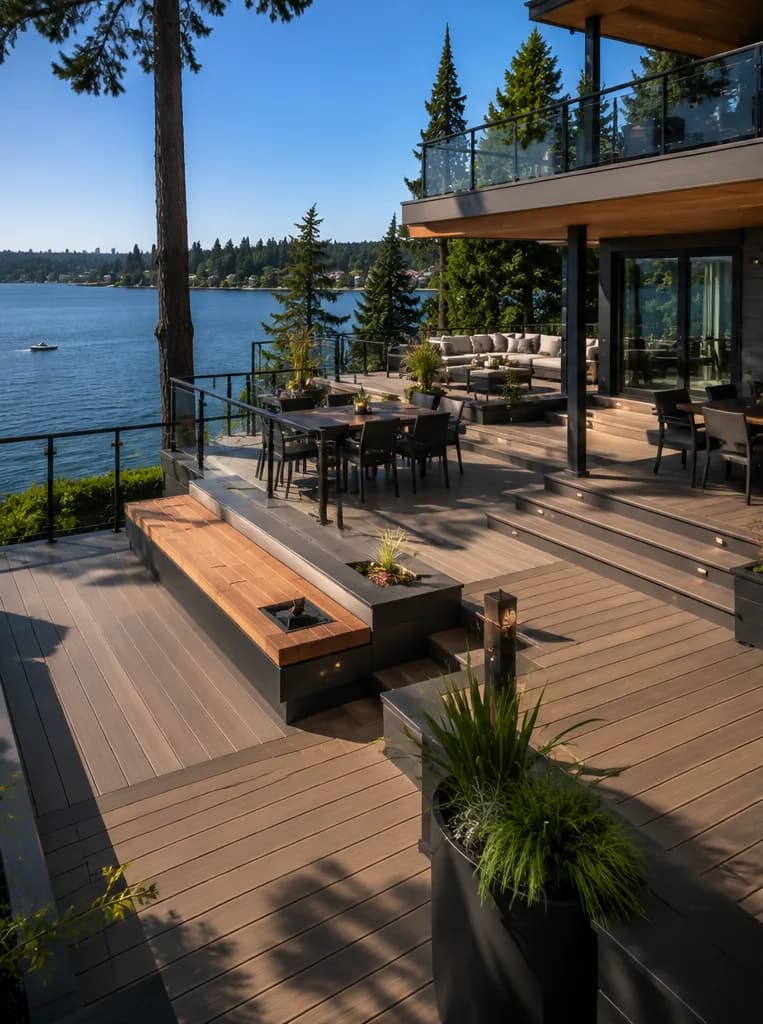
For 2026, most custom composite decks in our area land somewhere between roughly $45 and $80 per square foot installed. A well-appointed mid-size composite deck commonly runs $25,000 to $55,000, and larger multi-level or waterfront projects with premium features go up from there.
That's a wide range on purpose, because two decks of the same square footage can differ in price by tens of thousands of dollars depending on the factors below. Anyone who quotes you a firm number over the phone without seeing your site is guessing.
What actually drives the price
1. Material
The boards are the most visible cost lever:
- Pressure-treated lumber is cheapest up front but highest maintenance — and a poor long-term value once you factor in staining and replacement.
- Cedar sits in the middle, with ongoing sealing costs.
- Capped composite (Trex, Fiberon, TimberTech) costs more per board but far less to own over time.
- Capped polymer / PVC (TimberTech AZEK) is the premium surface.
We walk through the trade-offs in choosing the best decking material for a PNW home.
2. Height and stairs
This is the cost driver people underestimate most. A ground-level deck is straightforward. The moment a deck gets tall enough to need guard railings, longer posts, and a staircase, the labor and material climb quickly — and height is also what usually triggers a permit, which we cover in deck permits in Snohomish County and the Eastside.
3. Railings
Railing is where a deck looks custom or looks builder-grade, and the price spread is huge. A basic composite or aluminum rail is economical; cable and glass railing systems cost considerably more but transform the look and preserve views. See best railing systems for modern PNW decks for the full comparison.
4. Site conditions
Our region's terrain isn't free. Hillside lots, lakefront access, poor soil, and tight side-yard access for crews and materials all add labor and engineering. A flat, open Snohomish backyard is far cheaper to build on than a steep, tree-covered lakefront in Bellevue.
5. Design complexity and add-ons
Curves, picture-frame borders, multiple levels, and inlay patterns add craftsmanship hours. Then there are the features that turn a deck into an outdoor room: lighting, pergolas, covered roofs, outdoor kitchens and fireplaces. Each is worth it for the right home — and each adds to the number.
Why the cheapest bid is rarely the cheapest deck
Here's the part nobody enjoys hearing. The lowest bid usually achieves its price by cutting the things you can't see: undersized framing, fewer footings, skipped flashing at the ledger, builder-grade fasteners, and no real drainage. The deck looks identical on day one. The difference shows up in year eight, when the frame is failing and the "savings" turn into a rebuild — and sometimes into rot in the wall of your house, a risk we detail in signs your aging deck is damaging your home.
A deck is one of the few purchases where the structure you're paying for is invisible by the time the project is done. That's exactly why it pays to know what's underneath.
Composite costs more up front — and less to own
Sticker shock on composite is real, but it's the wrong frame. A wood deck has a low purchase price and a long tail of costs: stain, sealer, your weekends, and eventual board replacement. A composite deck front-loads the cost and then asks almost nothing of you for decades.
Over a 15-to-20-year horizon, a quality composite deck typically costs less to own than a wood deck that needs constant upkeep — and it almost always protects resale value better, which we get into in does a deck add value to your home.
How to budget smart
- Size to your life, not the lot. A right-sized deck you fully use beats an oversized one you furnish half of.
- Spend on the structure and the railings. These are the elements you can't cheaply upgrade later.
- Phase the extras. Lighting, a pergola, or a covered section can come later if the frame is built to accommodate them from the start.
Get a real number for your space
The only accurate estimate is one based on your actual site. Request a free estimate and Josh will walk your space, talk through your priorities, and hand you an honest, itemized breakdown — no bait pricing, no high-pressure sales. Just a real plan, built dam good.
Common Questions